 Our Location

Bursa Orthodontic Treatment: Scientific Approaches to Dental and Jaw Harmony
A healthy oral structure is directly linked to the proper alignment of the teeth on the jawbone and the perfect bite relationship established between the upper and lower jaws. Crowding, spacing (diastema), or jaw discrepancies are not only aesthetic concerns; they are also medical conditions that affect chewing function, speech ability, and temporomandibular joint (TMJ) health. Orthodontics, one of the specialties of clinical dentistry, deals with the diagnosis, prevention, and treatment of such anomalies.
According to current data from international orthodontic associations, dental alignment disorders (malocclusion) reduce individuals' brushing effectiveness, increasing susceptibility to interproximal caries and periodontal (gum) disease. In Bursa orthodontic treatment applications, the aim is to move the teeth within physiological limits and achieve ideal occlusion by using scientific methods appropriate to the patient's skeletal structure and the degree of the dental anomaly.
In this clinical guide, we will examine the physiological effects of orthodontic anomalies, treatment indications, appliance options, and the medical steps in the Bursa orthodontic treatment process in detail.
Need for Orthodontic Treatment and Malocclusion Classifications
An orthodontic anomaly (malocclusion) is a deviation from the normal anatomical alignment of the teeth. It may be skeletal (related to the size or position of the jawbones) or purely dental (the angulation of the teeth on the jawbone). The movement of teeth within bone occurs through a completely biological and cellular process called "bone resorption (osteoclastic activity)" and "bone formation (osteoblastic activity)".
Clinical Effects of Crowding and Bite Problems
Failure to treat orthodontic problems can lead to long-term structural issues in oral and dental health:
Risk of Tooth Decay and Gum Disease: The interdental surfaces of crowded teeth are much more prone to plaque accumulation (tartar) because they cannot be adequately cleaned with a toothbrush and dental floss.
Uneven Distribution of Chewing Forces: In cases of improper bite (malocclusion), the chewing load is disproportionately placed on certain teeth. This leads to enamel wear (abrasion), microcracks, and gum recession.
Temporomandibular Joint (TMJ) Dysfunction: Improper closure of the lower and upper jaws can lead to spasms in the chewing muscles, clicking in the jaw joint, and chronic head/neck pain.
Key Signs Indicating the Need for Treatment
Bursa orthodontic treatment centers commonly see patients with the following primary conditions that require orthodontic intervention:
Overbite (Deep Bite): The upper front teeth excessively cover the lower front teeth in the vertical plane.
Underbite: The lower jaw and lower teeth are positioned in front of the upper teeth (Class 3 malocclusion).
Open Bite: A vertical gap remains between the front teeth while the back teeth are in contact; the lips cannot close completely.
Diastema (Gapped Teeth): Non-physiological spaces between the teeth due to a wide jawbone or small tooth size.
Bursa Orthodontic Treatment Options and Appliance Types
In clinical orthodontic practice, different treatment devices (appliances) are used depending on the patient's age, the severity of the orthodontic problem, and biological adaptation capacity. In the Bursa orthodontic treatment process, the following methods may be applied according to the diagnosis of the specialist doctor (orthodontist):
Traditional Metal and Aesthetic (Porcelain) Brackets
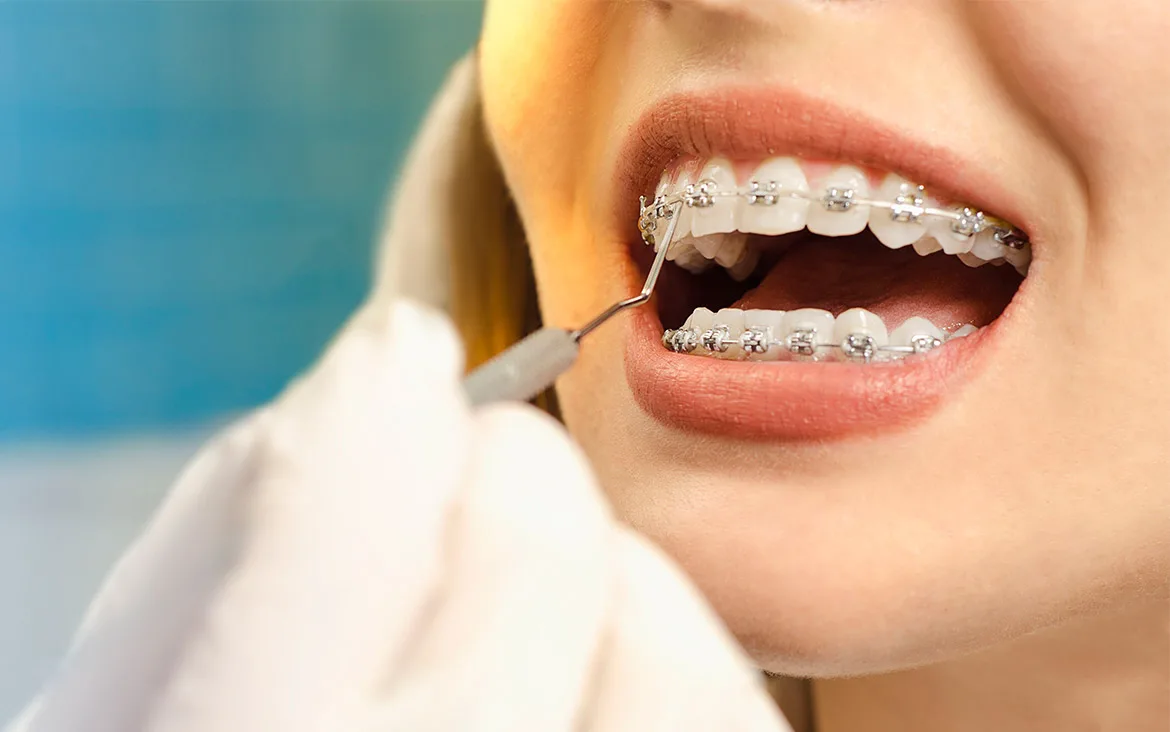
Fixed orthodontic treatment is carried out through "brackets" fixed to the tooth surface with medical adhesives and "arch wires" passing through these brackets.
Metal Brackets: These are classic orthodontic appliances made of stainless steel with the highest mechanical durability. They provide high control in the treatment of skeletal disorders or severe crowding. Because friction is low, tooth movement is highly predictable.
Porcelain (Ceramic) Brackets: They work on the same biomechanical principle as metal brackets, but because they are made from tooth-colored ceramic materials, they are less noticeable from the outside. They are preferred in adult patients to balance clinical functionality and aesthetic expectations.
Clear Aligner (Braceless Orthodontics) Applications
Clear aligners used in current orthodontic practices are a method in which teeth are moved without wires being attached to the tooth surface, using transparent thermoplastic appliances custom-made for the patient with 3D printers.
Clinical Function: After taking the patient's digital measurements, tooth movements are simulated on a computer. Based on this simulation, a series of aligners is produced. The patient wears each aligner for the period recommended by the doctor (usually 7-14 days), enabling the teeth to be corrected step by step.
Medical Advantage: The fact that the patient can remove the aligner while eating and brushing allows oral hygiene to be maintained much more easily and effectively compared with fixed braces. It helps maintain periodontal health in patients prone to gum disease.
Treatment Process and Clinical Planning Steps
For orthodontic movements to occur in accordance with bone biology, it is medically necessary for the process to be planned step by step within a specific clinical discipline. The general medical steps followed in the Bursa orthodontic treatment process are summarized below.
Radiographic Analysis and Diagnosis
The first and most important stage of treatment planning is an accurate diagnosis. At the initial examination, in addition to standard dental X-rays (panoramic), a "Cephalometric Radiograph" is taken to examine the skeletal structure, the angular relationships of the jawbones to the cranial base, and the soft tissue profile. The data obtained are measured with millimetric and angular precision to scientifically determine whether the anomaly is skeletal or dental. When necessary, 3D models are created using intraoral digital scanners.
Treatment Duration and Patient Compliance (Cooperation)
Orthodontic treatment durations usually vary between 8 months and 30 months depending on the patient's biological bone response, the severity of the case, and the method used. One of the most important components of clinical success during this period is patient compliance.
Avoid acidic drinks, sticky foods, and excessively hard foods (nuts, seeded fruits) to prevent damage to the brackets and wires.
Ensure complete daily oral hygiene with interdental brushes, special orthodontic brushes, and a water flosser to prevent food buildup around fixed orthodontic appliances.
Attend appointments regularly on a periodic basis (usually every 4-6 weeks).
Functional Benefits of Orthodontic Treatment
According to clinical evaluations, the functional parameters of an oral structure that has achieved proper occlusion are significantly superior to untreated conditions.
Clinical Parameter | Untreated Crowding / Malocclusion | Ideal Alignment After Orthodontic Treatment |
Oral Hygiene and Cleaning | High plaque accumulation and tartar formation occur because brushes cannot reach crowded interdental surfaces. | Because the tooth surfaces are smooth, nearly 100% cleanability is achieved with a toothbrush and dental floss. |
Tooth Surface Wear | Due to uneven bite, enamel wear and premature contacts occur on some teeth. | The force is distributed evenly across the jaw, and the enamel tissue is preserved within physiological limits. |
Jaw Joint (TMJ) Load | The risk of asymmetric muscle contractions, joint disc deformation, and pain increases. | Since the lower and upper jaws work in harmony, traumatic pressure on the joint is eliminated. |
Digestive System Effect | Since food cannot be ground sufficiently, additional workload is created in the stomach and digestive tract. | Thanks to effective chewing (mastication), digestive enzymes mix more healthily in the mouth. |
Conclusion: Orthodontic Guidance for Functional Integrity
Orthodontic treatment is a preventive field of medicine that can be applied to anyone with healthy teeth and gums regardless of age, and it permanently protects oral health. Leaving crowding and jaw irregularities untreated may pave the way for tooth loss, advanced gum disease, and joint disorders requiring surgical operations as age advances. In Bursa orthodontic treatment centers with specialist doctors, it is possible to achieve ideal jaw function and a healthy alignment through evidence-based medical practices that respect your biological tissues. To determine the most suitable appliance for your case and to have a personalized skeletal analysis, it is recommended that you make an appointment with your orthodontist and undergo a clinical evaluation.
Legal Notice and Information
This content has been prepared solely to scientifically and medically inform the public about oral health and orthodontic practices, in full compliance with the Law No. 1219 on the Practice of Medicine and Branches of Art and the Regulation on Promotional and Informational Activities in Health Services of the Ministry of Health. The information in the content does not include a definitive diagnosis or treatment guarantee for any disease and does not contain commercial guidance. To clinically determine whether you have a skeletal or dental anomaly, you must consult an orthodontist and undergo a physical examination.
It's Your Turn! Are you experiencing any difficulty in your own oral structure or chewing function that you think is caused by tooth alignment? Does clear aligner treatment or traditional braces seem more suitable for your biological and social life? Or does someone close to you have prior experience with the Bursa orthodontic treatment process? Share the questions you're curious about, your concerns, or your clinical experiences in the comments section below; let our specialist doctors answer your questions with medical sensitivity!