 Our Location

Bursa Orthodontics Guide: Achieve a Healthy and Flawless Smile
Our smile is the strongest and most natural bridge of communication we have with the outside world. Being able to smile freely, without needing to cover your mouth, is not only an aesthetic advantage but also a major source of confidence. However, due to genetic factors, baby teeth lost at an early age, or childhood habits such as thumb sucking, misalignments in tooth arrangement and jaw structure can occur. This is where orthodontics, one of the most established and results-oriented specialties in dentistry, comes into play.
Bursa, one of the largest healthcare centers in Marmara, is home to advanced dental clinics and experienced specialists. The modern treatment options offered in the field of Bursa orthodontics have now moved beyond being a process limited to childhood or adolescence and have become an accessible, aesthetic, and comfortable health investment for individuals of all ages. So, what exactly does orthodontic treatment cover, and what are the advantages of receiving treatment in Bursa?
What Is Orthodontics and Why Is It Vital?
Orthodontics is the branch of dentistry that examines, diagnoses, and treats the positioning of teeth on the jawbones, the relationship between the jaws (bite), and the overall aesthetics of the lower part of the face.
Many people think of orthodontic treatment as simply "straightening teeth and looking better." In reality, the underlying truth is much broader. Crowded or overlapping teeth are quite difficult to clean. Blind spots that the toothbrush cannot reach create conditions over time for tartar buildup, gum disease, and inevitably tooth decay. In addition, an incorrect bite can impair chewing function, leading to temporomandibular joint (TMJ) disorders, chronic headaches, and even digestive problems. A successful orthodontic treatment is more than an aesthetic smile; it is long-term insurance for oral and overall health.
In Which Situations Is Orthodontic Treatment Needed?
The main oral and dental conditions that require you to consult an orthodontics specialist (orthodontist) are as follows:
Crowding (Crowded Teeth): When there is not enough space in the jawbone for the teeth to fit, causing them to overlap or erupt crookedly.
Diastema (Gapped Teeth): Noticeable spaces between teeth, usually due to genetic reasons or missing teeth.
Overbite (Deep Bite): The upper front teeth covering the lower front teeth vertically more than normal.
Underbite: The lower jaw being positioned ahead of the upper jaw.
Crossbite: When the jaws are closed, some of the upper teeth remain behind (on the inner side of) the lower teeth.
Open Bite: A vertical gap remaining between the front teeth while the back teeth are in contact (usually caused by prolonged pacifier use or thumb sucking).
Modern Orthodontic Treatment Methods Applied in Bursa
As of 2026, thanks to the integration of technology into dentistry, treatment processes have become much faster, less painful, and less visible compared to previous years. In Bursa orthodontics clinics, different treatment protocols are applied according to the patient's clinical condition, age, and budget:
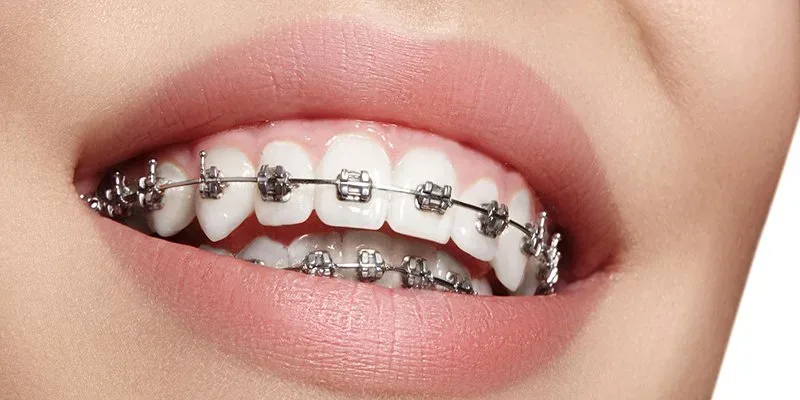
1. Traditional Metal Braces
When orthodontics is mentioned, this is the first method that comes to mind, and it is the most durable and widely used. Continuous and gentle force is applied to the teeth through metal brackets bonded to the teeth and wires passing through these brackets. Today, bracket sizes have become much smaller and less noticeable. It is the method that provides the fastest and most predictable results, especially in severe crowding cases.
2. Aesthetic Brackets (Porcelain / Sapphire)
An excellent alternative for teens and adults who are bothered by the appearance of metal. These brackets, produced from white porcelain or transparent sapphire materials that match the color of the teeth, are almost indistinguishable from a distance. Because they are structurally somewhat more delicate than metal braces, extra care is needed when consuming hard foods.
3. Clear Aligner Treatment (Removable Orthodontics / Invisalign)
It is undoubtedly the most popular orthodontic innovation of recent years. With digital impression (3D scanner) methods, the patient's oral structure is transferred to a computer environment, and the process through to the end of treatment is simulated. The patient is given sets of clear aligners that gradually move the teeth and are completely invisible from the outside.
Its biggest advantage: You can remove the aligners yourself while eating, brushing your teeth, or before an important meeting. Maintaining oral hygiene is much easier than with metal braces.
4. Lingual Orthodontics (Invisible Braces)
This is a system in which the brackets are bonded not to the front surface of the teeth, but to the inner (back) surface facing the tongue. From the outside, it is impossible to tell that the patient is undergoing treatment. It is often preferred by professionals with very high aesthetic concerns, those who work in front of cameras, or those constantly in the public eye. The adjustment period may be a little longer than with traditional braces.
Orthodontics by Age: Is It Only for Children?
There is no age that is "too late" for orthodontic treatment. Looking at the patient profile of Bursa orthodontics clinics, it can be seen that the proportion of adult patients is increasing day by day.
Childhood Treatments (Preventive Orthodontics): Specialists recommend that a child's first orthodontic examination be performed at around 7-8 years of age, when the permanent front teeth begin to erupt. Since jaw development is not yet complete at this stage, potential jaw narrowness or skeletal irregularities can be easily guided with removable appliances (palatal appliances).
Adult Orthodontics: Even if jawbone development is complete, teeth can still be moved at any age. A person aged 20, 40, or 60 with healthy bone structure and gum tissue can safely undergo orthodontic treatment. Especially with the introduction of clear aligners into our lives, the number of adults who want treatment without affecting their work and social life has increased rapidly.
Bursa Orthodontics Prices 2026: Factors Determining Costs
The cost of this valuable investment in your health is shaped by a completely personalized plan. While there is no single fixed answer to the question "How much are braces prices in Bursa?", the main factors affecting pricing are as follows:
Difficulty of the Case: The extent of the crowding in the teeth and the estimated duration of treatment (the cost of an aesthetic correction lasting 6 months and a skeletal case lasting 2.5 years will differ).
Chosen Material: Traditional metal brackets are generally the most economical option. Porcelain brackets, clear aligner systems (Invisalign, etc.), and lingual orthodontics rank higher on the price scale due to the fact that the materials used are imported and laboratory costs are involved.
Single-Jaw or Double-Jaw Application: If the problem is only in the upper or lower jaw, the cost decreases; however, for a healthy bite, specialists generally recommend treating both jaws.
Before starting the treatment process, the healthiest approach is to determine a clear budget and payment plan (installment options) as a result of the clinical examination and radiological X-ray analysis you will undergo with a specialist orthodontist.
Do not wait for cavities or tooth loss to occur in order to smile freely, have a healthy digestive system, and protect the permanent teeth you will use for life. With modern orthodontic solutions in Bursa, you can lay the foundation for an aesthetic and healthy future for yourself and your children starting today.