
 Our Location

Invisalign Treatment in Bursa: A Guide to Braceless Orthodontics with Clear Aligners
Crowding, gaps, or jaw bite problems (malocclusion) in tooth alignment not only affect the aesthetics of your smile, but also increase the risk of cavities, tartar, and gum disease due to the teeth not being cleaned effectively. In the past, the solution to such orthodontic problems was only through metal or porcelain brackets (braces). However, today many adults and young individuals postpone orthodontic treatment because they do not want a metallic appearance in the mouth due to work life or social concerns.
Clear aligner systems, the most advanced point reached by modern orthodontics and 3D digital dentistry technologies, move teeth to their ideal positions without the need for braces. Invisalign treatment in Bursa protocols applied in clinics with Bursa's advanced dental infrastructure and certified orthodontic specialists offer a comfortable treatment process with nearly invisible, custom-made clear aligners. In this comprehensive clinical guide, we will examine the biomechanical working principle of clear aligners, their differences from traditional braces, and all the medical details of Invisalign treatment in Bursa processes.
What Is Invisalign (Clear Aligner) Treatment and How Does It Work?
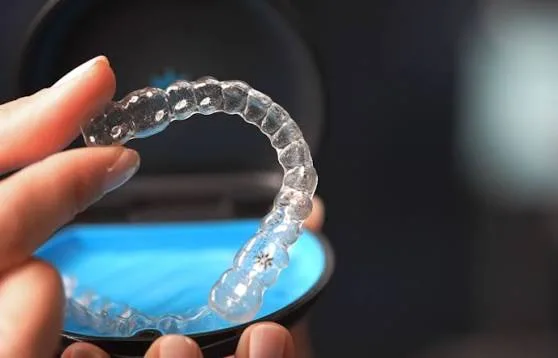
Invisalign is a series of removable orthodontic aligners made of fully transparent, medical-grade thermoplastic material (SmartTrack), produced with 3D printing technology specifically for the patient's oral structure. Unlike metal brackets and wires, they are not bonded to the teeth; they encircle the teeth and apply controlled, gradual biomechanical forces.
Biomechanical Force and the Principle of Tooth Movement
The basis of orthodontic treatment is the remodeling of the bone tissue surrounding the tooth root under controlled pressure (bone apposition and resorption). In a properly planned Invisalign treatment in Bursa application, the patient is given a series of aligners, each designed to move the teeth by an average of 0.25 mm. The patient wears each aligner for the period specified by the doctor (usually 7 to 10 days), for an average of 20-22 hours a day. When the time is up, the patient switches to the next aligner, and the teeth gradually reach the final digitally planned alignment. In cases where necessary, small tooth-colored composite attachments placed on the tooth surface help the aligner grip the tooth better and ensure the complete execution of complex rotational movements.
Who Is Suitable for Invisalign Treatment?
Thanks to technological advances, clear aligners are now used successfully not only in simple tooth crowding, but also in advanced orthodontic cases:
In mild, moderate, and severe crowding in the front or back teeth.
For closing aesthetic spaces between teeth (diastema).
In bite discrepancies between the lower and upper jaws (deep bite, open bite, crossbite).
In individuals who have previously undergone braces treatment but whose teeth have shifted again (relapsed) because they did not use retention appliances.
Both in adult patients and in younger individuals whose permanent teeth have erupted (Invisalign Teen).
How Do Digital Planning (ClinCheck) and the Treatment Process Proceed?
At a qualified Invisalign treatment in Bursa center, the process is carried out with digital simulations, completely moving away from traditional impressions and uncertain treatment durations.
iTero 3D Intraoral Scanning and Treatment Outcome Simulation
In the first step of treatment, the orthodontist uses intraoral optical scanners (iTero 3D Scanner) to create a digital copy of the teeth and jaw bite within seconds. Classic impression trays that trigger the gag reflex are not used. The resulting 3D data is transferred to the special "ClinCheck" software. Thanks to this software, the doctor plans each tooth's weekly movement to the millimeter. The biggest advantage is that the patient can see live, on a 3D animation, what their teeth will look like when treatment is complete, even before treatment has started.
Production, Use, and Check-Up Sessions of the Aligners
Custom Production: After the digitally planned treatment approved by the doctor, the full set of clear aligners to be used throughout the patient's treatment is produced in special laboratories and delivered to the clinic.
Attachment Placement and Delivery: In the first session, invisible micro-attachments are placed on the necessary tooth surfaces and the first set of aligners is delivered to the patient.
Daily Wear Discipline: To ensure the treatment is completed within the planned time, the aligners must be worn for 20 to 22 hours a day, except while eating and consuming hot drinks.
Flexible Check-Up Appointments: Unlike metal braces, there is no wire poking, bracket breakage, or monthly tightening pain. Check-ups are usually performed every 6 to 8 weeks; this offers great convenience for patients coming from out of town or those with a busy work schedule.
Comparison of Invisalign Treatment and Traditional Braces
When deciding on orthodontic treatment, the issue patients are most curious about is the clinical and daily life differences between clear aligners and classic fixed braces.
In the table below, you can examine the scientific and practical comparison of the two methods:
Comparison Criterion | Invisalign Treatment (Clear Aligner) | Traditional Braces (Metal / Porcelain Bracket) |
Aesthetic Appearance | Nearly completely invisible, not noticeable. | Clearly visible when speaking and smiling. |
Oral Hygiene and Cleaning | Can be removed while eating and brushing teeth. | Fixed; requires special care with dental floss and interdental brushes. |
Food Freedom | There are no food restrictions since the aligners are removed. | Hard, shell-like, and sticky foods can break the brackets. |
Comfort and Soft Tissue | Thanks to its smooth surface, it does not cause sores on the lips or cheeks. | In the early stages, wire poking and irritation inside the cheeks may occur. |
Check-Up Frequency | An average check-up every 6 - 8 weeks is sufficient. | Regular wire changes and adjustments are needed every 4 weeks. |
Patient Cooperation | Wearing the aligners for 20-22 hours a day is the patient's responsibility. | Since it is bonded to the tooth, it works independently of patient compliance. |
Post-Treatment Retention (Retainer) Process and Care Recommendations
The permanence of orthodontic treatment depends on the retention phase at the end of treatment as much as on the active aligner process. After the teeth are moved to their new positions, it takes time for the surrounding bone and gum fibers to fully adapt to this position. Therefore, at the end of Invisalign treatment in Bursa protocols, thin protective wires (lingual retainers) are fixed to the back surfaces of the teeth or clear retention aligners (Vivera) for night use are provided to prevent the teeth from returning to their former positions (relapse).
The basic rules to pay attention to during the aligner use process are as follows:
While the aligners are in the mouth, only cold or room-temperature water should be drunk; hot tea and coffee may deform the thermoplastic structure.
After each meal, the teeth should be brushed and the aligners should be put back in; the aligners should be cleaned with cold/lukewarm water and a soft brush (without using abrasive toothpaste).
Removed aligners should always be stored in their special protective case to prevent loss or breakage.
Conclusion: Smile Freely with Invisible Technology
Tooth crowding and bite problems are not health issues that should be postponed, even at later ages. It is possible to achieve a healthy and symmetrical smile without the aesthetic concerns and dietary restrictions caused by traditional braces, and without compromising your daily comfort, thanks to today's digital orthodontic technologies.
Invisalign treatment in Bursa applications carried out by expert and certified orthodontists with 3D digital planning offer you a predictable, painless, and aesthetic treatment experience. Before irregularities in your tooth alignment negatively affect your gum and jaw joint health, do not delay booking a digital scan and examination appointment with specialist doctors.